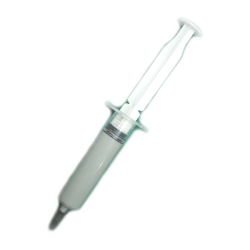
One-component acid-free RTV-type silicone adhesive, for use in LED lamps, sealing electronic modules.
UV and ozone resistant.
Non-flammable, water resistant.
Good dielectric properties.
Viscous, thixotropic mass of white color.
It is chemically neutral, does not contain acids, and therefore does not cause corrosion of the bonded surfaces. No pungent odor.
Good adhesion primarily to metals and plastics.
Provides dielectric insulation and prevents aggressive environmental influences.
Retains its mechanical and dielectric properties in the temperature range from -50°C to +200°C.
Recommended for sealing various lighting fixtures, as well as for insulating electronic components on circuit boards in the automotive industry (headlight bonding).
Packaging: 100 gram tube.
Characteristics:
|
Characteristics |
Meaning |
|
Name |
K-5931WL |
|
Color |
White |
|
Consistency |
Pasty |
|
Density, g/cm³ |
1,2 ~ 1,4 |
|
Initial cure time |
≤ 20 minutes (at 25 °C) |
|
Tensile strength, MPa |
2,0 |
|
Elongation, % |
≥ 300 |
|
Shear strength |
≥ 1.0 MPa |
|
Shore A hardness |
35 ±2 |
|
Operating temperature range |
-50 ~ +200 °C |
|
Dielectric strength |
20 kV/mm |
|
Dielectric constant |
3.0 (at 60 Hz) |
|
Volume resistance |
1×10¹⁵Ohm*cm |
Recommendations for use:
Curing of one-component silicone compounds occurs due to interaction with moisture contained in the air. Cures well at room temperature in the relative humidity range from 30% to 80%. A level of about 90% of the values of their physical properties is achieved within a period of 24 to 72 hours. The curing of the composition can be accelerated with slight heating, not higher than 60 °C.
Silicone sealants should be stored in airtight containers, avoiding contact with air.
When working with adhesive-sealant, the time for applying the silicone mass is limited. Typically this period ranges from several minutes to one hour before the formation of a surface film that impairs adhesion.
It is not advisable to use a one-component compound in confined spaces or apply it in a thick layer, because in this case, the curing period increases significantly.










 -10%


 The data presented in the product description are for reference only and may differ from those indicated by the manufacturer.